Support

Find answers to common questions, troubleshoot connectivity issues, and learn about platform-specific details.

LYNQ & LYNQ+ General FAQ Hi-Res & Lossless DAC & Hardware Setup Connectivity macOS Issues Contact Us

FAQ

General Questions

Do I need an Apple Music subscription?
Yes, an active Apple Music subscription is required. Lysoniq is a client for Apple Music — it uses your existing subscription to play music. One subscription covers all your devices.
Is Lysoniq a subscription?
No. Lysoniq is a one-time universal purchase. You pay once, get all future updates, and can install it on any iPhone, iPad, Mac, Apple TV, or Apple Vision Pro linked to your Apple ID. Apple Family Sharing is supported — anyone in your Family group can install Lysoniq on their own devices using their own Apple ID, no extra purchase needed.
Can I use Lysoniq with multiple devices at the same time?
Yes. One device acts as the source (connected to your DAC/amp) and any number of other devices can act as controllers. All controllers stay fully synced — browse, queue, skip, and adjust from any of them.
What are the minimum OS requirements?
iPhone: iOS 16.4 or later
iPad: iPadOS 16.4 or later
Mac: macOS 14.6 (Sonoma) or later
Apple TV: tvOS 17.6 or later
Apple Vision Pro: visionOS 1.0 or later

The App Store listing is always authoritative if these change in a future release.
How do I select which device to play the music from?
Source = the device connected to your DAC, amp, or hi-fi system (or an Apple TV connected to your AV system). The source plays the actual audio.

Controller = any other device running Lysoniq on the same network. Controllers browse, queue, and adjust playback in sync with the source. You can have multiple controllers at once.

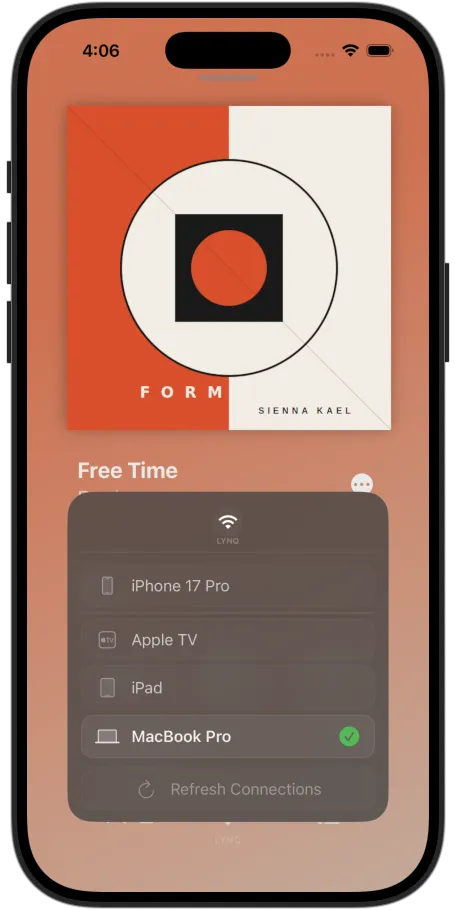
Inside the app, open the LYNQ devices screen from the Now Playing view and tap a device to choose which one plays. You can switch source at any time. (See Hi-Res & Lossless below for which device makes the best source.) Learn about LYNQ & LYNQ+ →
Lysoniq LYNQ devices screen — pick a device to set as the source
Can Lysoniq play my own files (uploaded MP3s, FLACs, etc.)?
Yes — anything in your Apple Music library plays through Lysoniq, including content you've uploaded or matched via Sync Library (Apple's syncing feature, previously called iCloud Music Library). As long as your own files have been added to Apple Music and synced to your devices, Lysoniq will play them like any other library track. Local files outside your synced Apple Music library aren't supported.
Does Lysoniq collect personal data?
No. We do not collect personal information. Anonymous analytics may be used to improve functionality. See our Privacy Policy for details.

Audio Quality

Hi-Res & Lossless

What each device supports and how to choose your source for the highest quality.

What audio quality does each device support?
iPhone & iPad: Up to 24-bit/192kHz (Hi-Res Lossless) via an external DAC.

Mac: Up to 24-bit/96kHz (Hi-Res Lossless) via an external DAC.

Apple TV: Up to 24-bit/48kHz (Lossless) via HDMI.
Which device should I use as my source?
There are two main angles when choosing a source: audio quality ceiling and how reliably the device stays available.

For maximum quality, pick an iPhone or iPad. They support Hi-Res Lossless playback (up to 24-bit/192kHz) when connected via an external DAC.

For a "set and forget" streamer that's always available, a Mac is the most consistent choice. iOS isn't designed to run apps indefinitely in the background — under memory pressure or long idle periods, the OS can suspend or kill Lysoniq, which may break controllers' connections until you reopen the app on the source. The Background Connections setting (on by default in iOS) keeps networking alive across short inactivity periods, but it's not a forever-guarantee. macOS lets apps run uninterrupted as long as the Mac is awake. Mac caps at 24-bit/96kHz.

Apple TV can act as a source (capped at 24-bit/48kHz over HDMI), but in many setups it's better used as a controller — the larger screen and Siri Remote can be more comfortable for browsing than a phone, while your iPhone, iPad, or Mac (connected to your DAC) keeps handling the actual audio playback.

Hardware Setup

DAC & Hardware Setup

Lysoniq plays through whatever audio output your source device is using, so you have flexibility in your choice of DAC, amp, or other audio hardware. The connection type you choose may impact the maximum quality you'll deliver to your external device.

Do I need a USB-compatible DAC?
No — Lysoniq works with most DACs, including older ones you may already have. Your iPhone, iPad, or Mac outputs digital audio over USB, but a simple cable or adapter can pass that signal to whatever input your DAC accepts: USB direct, S/PDIF coax, Toslink optical, or HDMI. Many audiophiles repurpose older DACs they have on hand — a small USB-to-coax or USB-to-optical cable is often enough to give a vintage DAC a second life. See the connection options below for the typical quality ceilings on each.

Connection options

USB direct

Plug your source device directly into the USB input on your DAC, amp, or audio interface. Older iPhones and iPads with a Lightning port use Apple's Lightning to USB Camera Adapter; newer USB-C devices use a USB-C-to-USB cable. Each platform's maximum sample rate and bit depth still applies (see Hi-Res & Lossless above).

USB → S/PDIF coax

Useful when your DAC has coax (RCA digital) but no USB. In our testing, USB-to-coax cables carried up to 24-bit/192 kHz. Results vary by product — check the specs of your specific cable before relying on hi-res over coax.

USB → Toslink optical

Useful when optical is your DAC's only digital input. In our testing, USB-to-optical cables tended to cap at 24-bit/48 kHz — fine for CD-quality lossless, but you'll lose hi-res. Results vary by product; some higher-end cables may reach 96 kHz or beyond, so check the specs.

USB-C → HDMI

Works with receivers and amps that have an HDMI input. In our testing, an iPad over a USB-C-to-HDMI cable to a receiver delivered 24-bit/192 kHz audio along with video — the video mirrors the device's screen on the connected display, which can be a useful side effect (visual feedback) or unwanted depending on your setup.

My DAC has multiple inputs — does it matter which one I use?
Pick the highest-quality input your hardware supports. Your DAC's input selector decides which input is active; the connection you use between your chosen Apple device and your DAC (or amp, or other audio hardware) may limit the maximum sample rate and bit depth that can be passed through (see the connection options above for the typical ceilings on each).
Why is the volume slider greyed out?
Lysoniq's volume slider mirrors what your iPhone, iPad, or Mac can actually control. Most audiophile DACs are designed to pass a fixed-level signal — they don't accept volume changes from the connected device, because volume is meant to be controlled downstream at your amp, preamp, or active speakers. When the OS sees a fixed-output DAC like that, there's nothing for it to adjust, so Lysoniq's slider greys out.

Troubleshooting

Connectivity

Lysoniq uses an advanced connectivity system designed to keep your devices connected with minimal intervention. In most cases, temporary disconnections are resolved automatically.

How Lysoniq stays connected

Lysoniq is designed to maintain a stable connection between your devices with minimal intervention. If a connection drops due to a brief WiFi interruption or a device going to sleep, Lysoniq will detect the issue and attempt to reconnect automatically within seconds. For device discovery, Lysoniq uses multiple methods to ensure your devices can find each other reliably across different network setups. If automatic recovery isn't resolving the issue, tap Refresh Connections in the app to perform a full reset of the discovery system.

On iPhone and iPad, enabling Background Connections in Lysoniq's Settings keeps networking active while the screen is off or the app is in the background — useful if a device frequently loses sync when locked or when you switch to another app.

If a connection drops, give it 15–20 seconds to reconnect on its own before troubleshooting manually.

Controlling devices across networks

By default, your devices connect to each other on the same Wi-Fi. LYNQ is the system that links them, and LYNQ+ extends that control over cellular and across different networks. Learn about LYNQ & LYNQ+ →

Manual troubleshooting

If automatic recovery doesn't resolve the issue, work through these steps in order.

01 Basic Checks

Check that the app is updated to the latest version on all devices.

Ensure all devices are on the same WiFi network.

Ensure the app is open and in the foreground on all devices.

Check that Local Network permission is enabled for Lysoniq. On iPhone or iPad, go to Settings → Privacy & Security → Local Network. On Mac, go to System Settings → Privacy & Security → Local Network. On Apple TV, the prompt appears the first time you launch the app — if it was dismissed or denied, delete Lysoniq and reinstall it to be prompted again.

02 Quick Fixes

Tap Refresh Connections in the app — this performs a full reset of the discovery system and resolves most connection issues.

Toggle WiFi off and back on for the device that isn't connecting.

Force-quit the app on the problem device and relaunch it.

If a device was recently on a different network (e.g. came home from cellular), toggle WiFi to force it onto the correct network.

On iPhone or iPad, enable Background Connections in Lysoniq's Settings if a device drops when the screen turns off or the app is backgrounded.

03 Router & Network Issues

Restart your WiFi router — this resolves most persistent connection issues, especially on mesh networks.

If you use a mesh WiFi system (Google Nest, Eero, Orbi, etc.) and devices aren't discovering each other, try restarting your router. Some mesh configurations can occasionally prevent devices from seeing each other until the router is restarted.

Check if your router has "AP isolation" or "client isolation" enabled — this blocks device-to-device communication and must be disabled for Lysoniq to work.

Some routers have separate 2.4GHz, 5GHz, and 6GHz networks. Ensure all devices are on the same band or SSID.

If using a VPN on any device, try disabling it — VPNs can prevent local network discovery.

04 Firewall & Security

On Mac, check System Settings → Network → Firewall — ensure Lysoniq is allowed to accept incoming connections.

Corporate or managed networks may block the local network traffic that Lysoniq relies on. Lysoniq may not work on these networks.

05 Still Not Working?

Try connecting all devices to a mobile hotspot as a test. If they connect there, the issue is likely with your router or network configuration.

If none of the above helps, open Lysoniq on the source device and non-connecting device, and go to Settings → Send Log & Crash Report. This sends us a diagnostic log which can help us identify the issue. Feel free to include a brief description of the problem in the email that opens. You can also contact us directly if you have any questions.

Platform-Specific

macOS Known Issues

These issues are caused by limitations in Apple's MusicKit framework on macOS. They do not affect iOS or tvOS. We monitor Apple's updates closely and will improve Mac support as new capabilities become available.

Some playlists are missing
This can happen when your Mac's music library is out of sync with iCloud. Toggling the Sync Library setting off and on will force a refresh. Here's how:
  1. Open the Music app on your Mac.
  2. From the menu bar, click Music → Settings (or Preferences on older macOS).
  3. Go to the General tab.
  4. Uncheck Sync Library and confirm when prompted.
  5. Wait a few seconds, then check Sync Library again to re-enable it.
  6. Give it a minute or two to re-sync, then relaunch Lysoniq.
Brief gap in playback when using auto sample-rate switching
When Lysoniq automatically changes the audio sample rate to match the next track, macOS briefly resets the audio output. This causes a short pause while your DAC switches to the new rate. This is normal behaviour on macOS — iOS handles this natively without any gap, and tvOS is fixed at 24-bit/48 kHz so no sample-rate switching is needed.

Tip: On Mac, manually pressing Next or Previous triggers the sample-rate switch before playback starts, so the new track begins without interruption. The gap only shows up during natural auto-progression between tracks at different sample rates.
Audio quality display may not match what's playing
Apple's MusicKit on macOS doesn't expose streaming quality metadata (this is available on iOS and tvOS). Lysoniq works around this by assuming the highest quality format available for each track. For the most accurate display, ensure Hi-Res Lossless streaming is enabled in your Apple Music Playback settings and Dolby Atmos is turned off.
Dolby Atmos limited to 2 channels
Apple's MusicKit framework currently limits Dolby Atmos output to two channels on Mac. This is an Apple-side limitation — we'll update Lysoniq when Apple expands this capability.

Still need help?

We typically respond within 24 hours.

Email info@lysoniq.app

You can also join the discussion at r/Lysoniq